Monday, November 18, 2013

The hand of Obregón

Nowadays magic is discredited to such extent that people with natural propensity to believe in it prefer to entertain themselves with conspiracy theories. Which is a shame, since paranoia is a harmful condition, both for the sufferer and for those who are secretly trying to kill him.

I insist that magic is good for us. An idiot who believes in magic is hardly more dangerous than an idiot who does not. At least, he (or she) is easier to spot. And, let us be honest, only by taking magic into the account we get coherent explanations for many events.

In the middle of the Bombilla Park in the south of Mexico City there stands an imposing monument. The entrance is guarded by two enormous statues holding a hammer and a sickle, the rear by an eagle compared to which the eagles of the Third Reich look like underfed sparrows. This is the mausoleum of the right hand of 
General Álvaro Obregón.

Álvaro Obregón was murdered in the name of Christ on July 17, 1928 and his body was buried in Huatabampo, Sonora. However, it was not buried complete. Obregón lost his right arm 1915 in an ambush by the forces of another national hero, Francisco Villa, and his hand was preserved in formaline. In 1935 it was placed into the basement of the Obregón Monument, in a niche behind steel bars.


The right hand of Álvaro Obregón
There it stayed until 1989 when President Carlos Salinas ordered it to be incinerated. Two years later the empty niche was filled with a bronze model of Obregón's arm. It didn't fit the niche well as it represented the whole limb and not just the hand, and it is still there to be observed. It looks ridiculous.


The bronze arm on display
Now, why did Carlos Salinas destroy the hand of Obregón? He certainly did not mind shooting his nanny when he was three years old. “I killed her with one shot,” he bragged, “I’m a hero.” Nor he seemed to be especially perturbed by the epidemic of violent deaths that hit the journalists during his presidency. People did not come out to the streets asking to burn the hand of Obregón (though they did ask for other things).

You have probably guessed the answer already. A relic of a saint or a hero has great magic powers. Salinas could not set the evil roam free in Mexico while Obregón's fist was on guard. Without it, he did what he did. (Yes, I know this is called economic development.)

Actually, I have seen a different explanation, which does not involve bestowing on Salinas the title of a black magician. Some well-meaning people conjecture that Salinas wanted to transform Mexico into a modern society and this implied getting rid of dead body parts that only serve to scare children and adults alike and make Mexicans look like savages.

Well, if thas was his intention he would have started with the Mummies of Guanajuato. And then, of course, this argument implies that a citizen of a modern society should be appalled by the sight of a dead body unless the latter is mounted on a bicycle, and, in general, should not be reminded of death. Needless to say, a person who manages to forget about his own imminent death must have severely impaired memory, and is even more likely to disregard whatever harm he or she inflicts on the outside world. While this makes him a perfect consumer, in other respects he is just as good as a zombie. I do not think that appealing to this kind of crowd is any better than practicing black magic.

And, in any case, death in Mexico is not going to be forgotten any time soon.

Tuesday, October 22, 2013

Whenever I have a stopover in my trip I lose something. This last trip from St Petersburg to Mexico had too many stops: in Moscow I left a wool jumper, in Bonn two pink umbrellas. In New York I left an unread issue of New Yorker a pair of Tommy Hilfiger sunglassess that I bought in Manhattan. Actually, the sunglasses turned up in my luggage later but, meanwhile, I convinced myself that they were quite ugly so they also qualify as a loss.

There is nothing new under the sun, of course; especially, if you are an idiot. In particular, my plight has been described in the classical Russian literature. Here is an attempt to a translate the relevant piece: "Losses" by Daniil Harms.
Andrey Andreevich Myasov bought a wick at the market and set off with it for home.
On his way Andrey Andreevich lost the wick and stopped at the shop in order to buy some hundred and fifty grams of Poltava sausage. Then Andrey Andreevich stopped at the milk cooperative and bought a bottle of kefir, afterwards had a small glass of bread ale at the stall and queued for a newspaper. The queue was quite long and Andrey Andreevich spent at least twenty minutes queueing but, as he was approaching the seller, the newspapers run out just under his nose.
Andrey Andreevich hesitated for a while and went home, but on the way lost the kefir and stopped at the bakery, where he bought a french baguette but lost the Poltava sausage. 
Then Andrey Andreevich went directly home, but on the way he fell, lost the french baguette and broke his glasses. 
Andrey Andreevich came home extremely irritated and went straight to bed but could not fall asleep for a long time; when he finally fell asleep he dreamed that he had lost his toothbrush and was brushing his teeth with some kind of a candlestick.
The works of Harms are often misclassified as humour. However, he was arrested several times (at least once clearly on the account of his writings) and died in a psychiatric ward in prison. Nobody could disregard the duty to lick the dictator's boots and be safe at the same time, but Harms was a real enemy: he observed a world that could not be improved by ideology.

Tuesday, September 24, 2013

Feeling of ...

Google autocomplete for "feeling of" is "impending doom".

That's a relief. I thought it was delirium tremens setting in.

Wednesday, September 18, 2013

Японское море имени Карла Маркса

Посмотрел фильм Довженко "Аэроград". В основном, про то, как мужик дикого вида с ружьем ходит по тайге и стреляет в разных других людей дикого вида. (Мужик защищал СССР.) Самолетов почти не было. Зато было много деревьев и кустов, а еще вот что:


В детстве это море у меня, видимо, плескалось в голове. В детский сад я не ходил, а сидел с бабушкой дома и слушал советское радио. Однажды я нарисовал странную картинку. Две синих избушки на курьих ножках, на каждой избушке была наклеена синяя марка об уплате профсоюзных взносов (у родителей выпросил) и сверху было написано синими кривыми буквами: "ГОРОД МГКАКА ПОЯСЕС".  "На Москву непохоже", - отметили мама с папой. 

В другой раз я гулял по улице и заглянул в открытую дверь подвала. Из темноты раздавались душераздирающие вопли. Я выскочил на улицу, поймал первого попавшегося прохожего и дрожащим голосом ему сообщил что, по моим наблюдениям, в ближайшем подвале прячутся корреспонденты "Нью-Йорк Таймс". Он решительно спустился в подвал, и, выйдя через минуту, сообщил мне с серьезным видом, что корреспондентов нет, зато кошки делают котят.

Подозреваю, что в то же время Америке дети (не все, только такие же тупые, как я) принимали мартовских котов за агентов КГБ.

(Как мы теперь знаем, можно быть и агентом, и корреспондентом. Но это к делу не относится.)


Wednesday, September 11, 2013

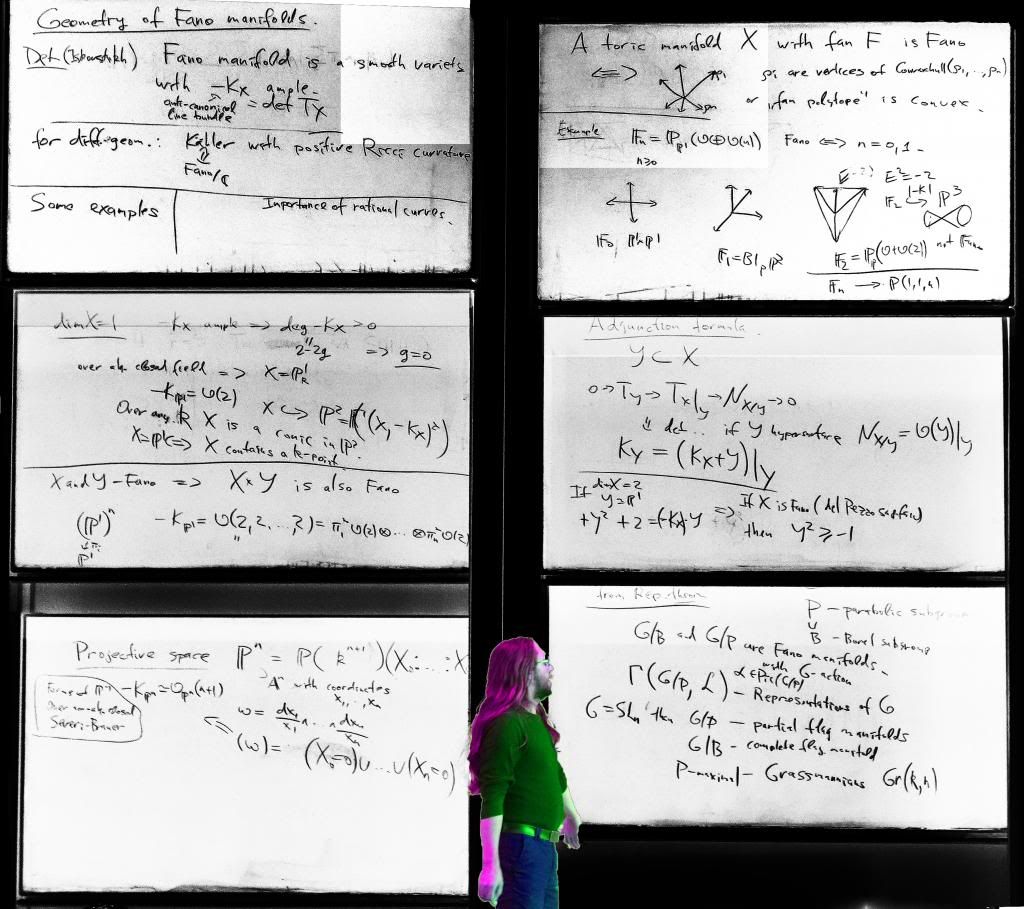
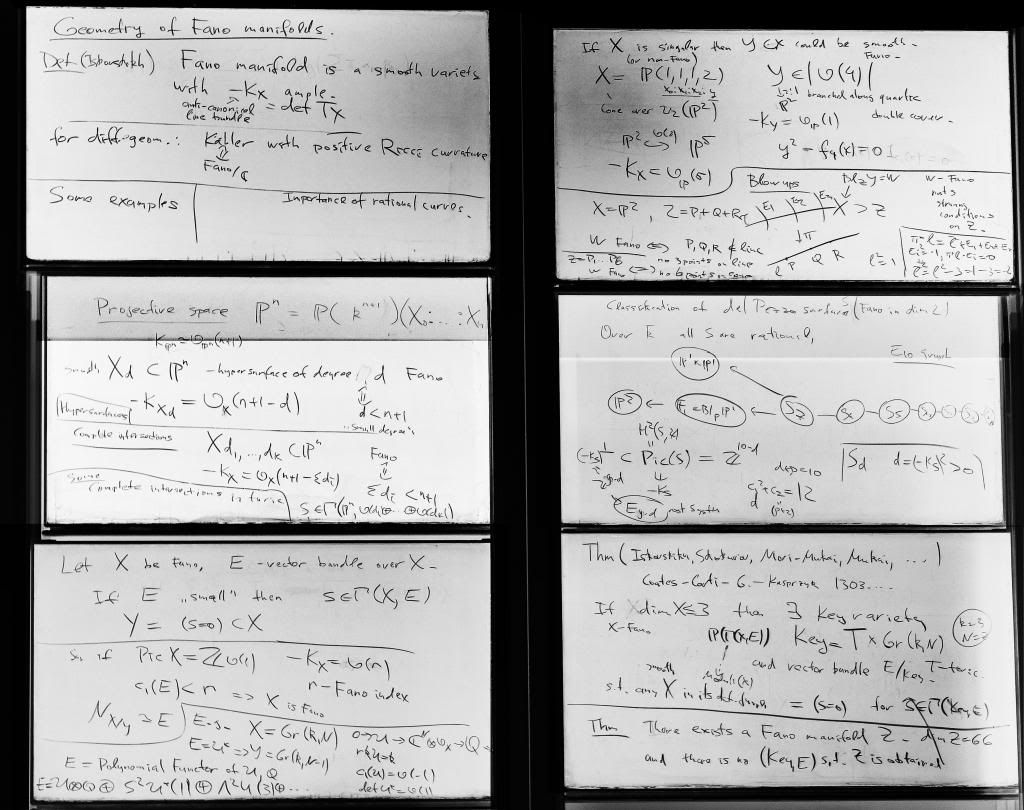
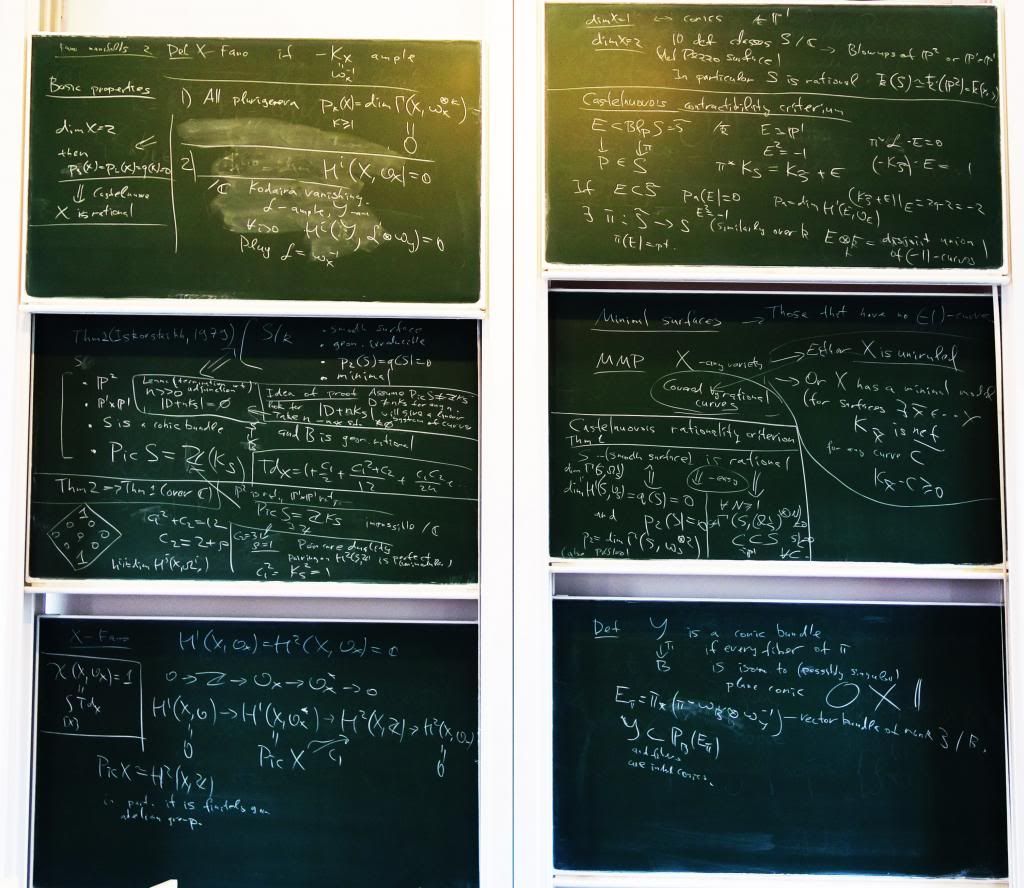
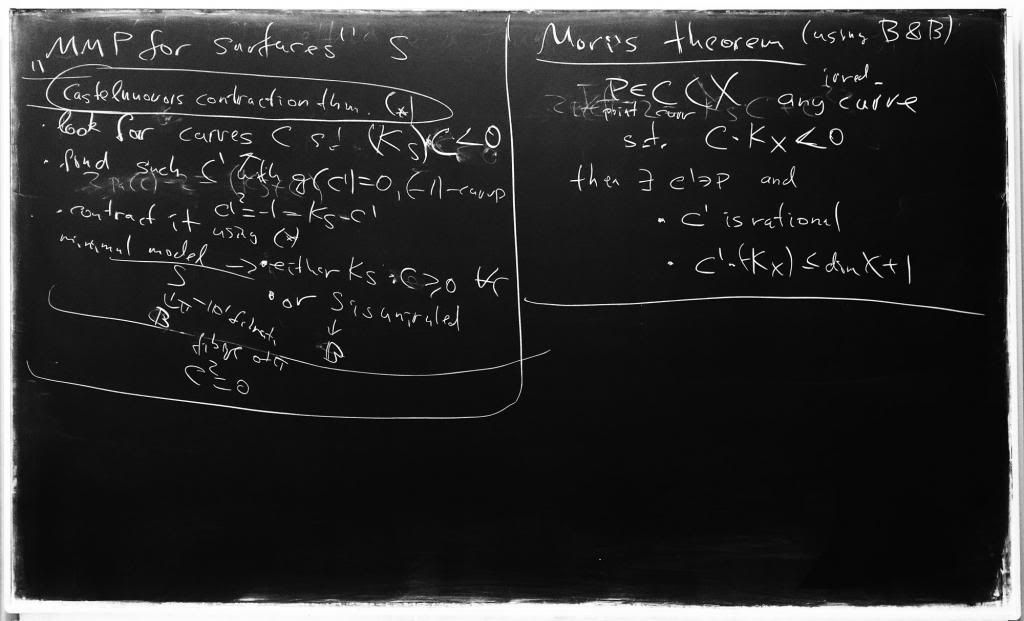
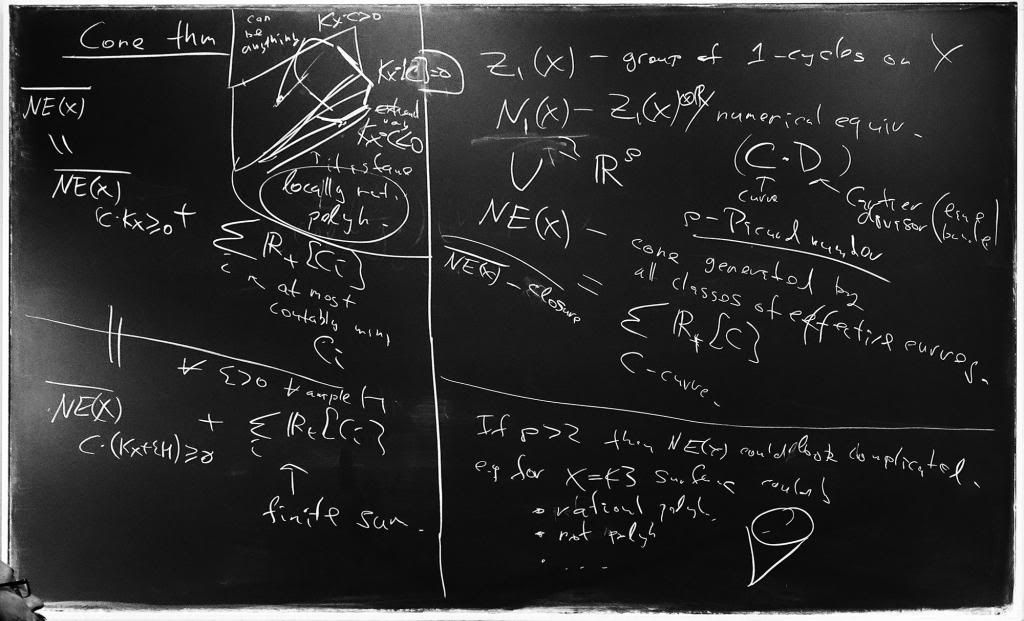
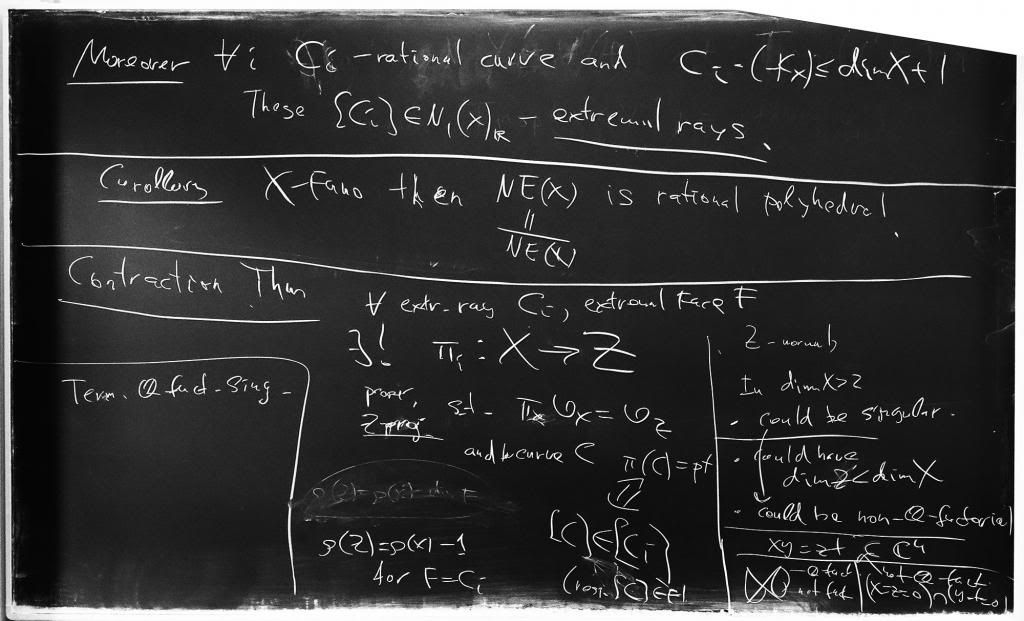
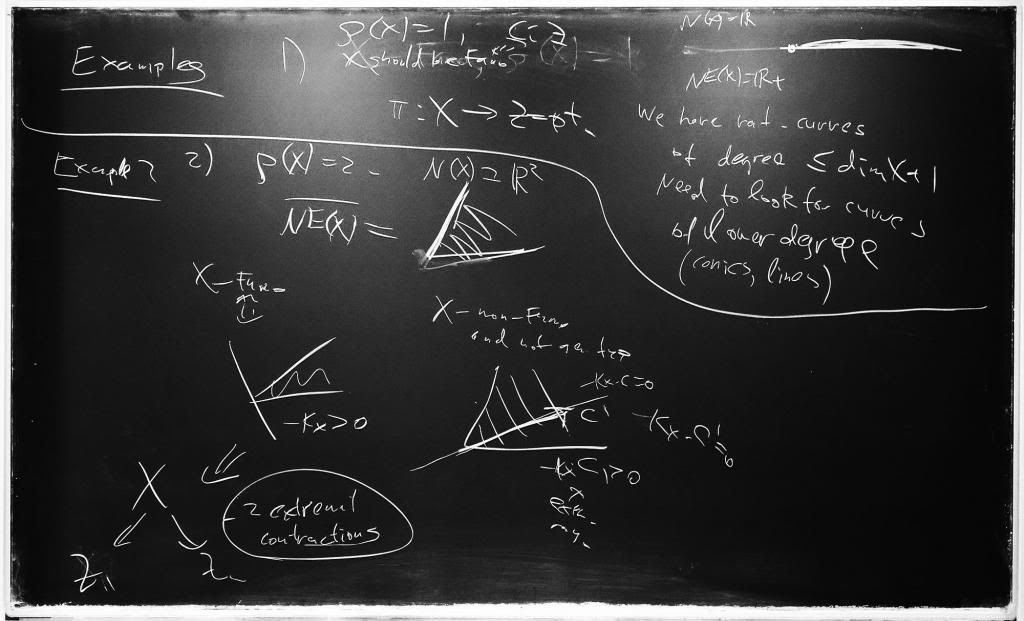
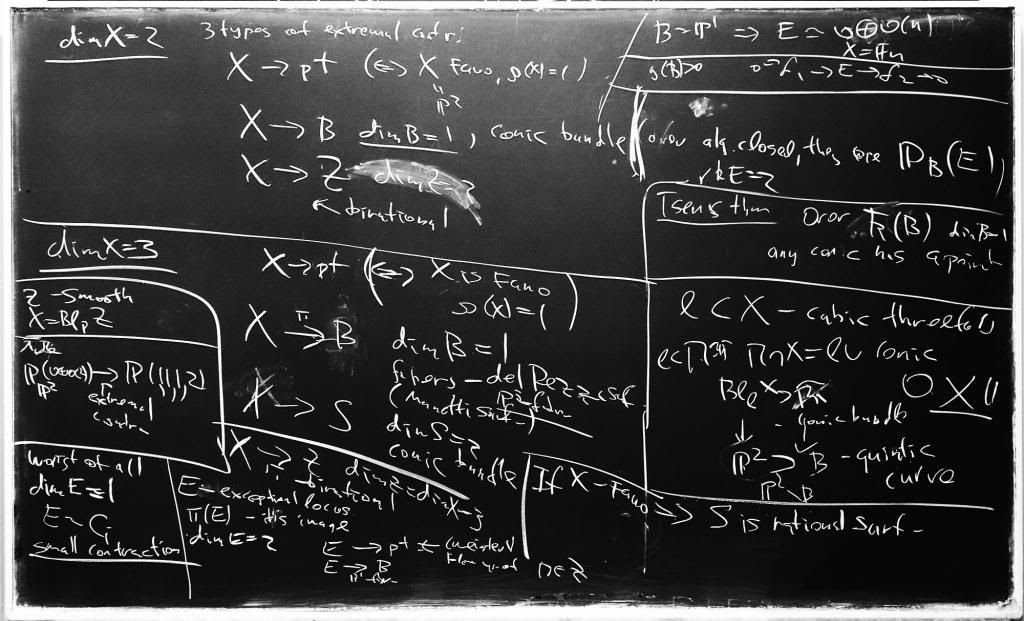
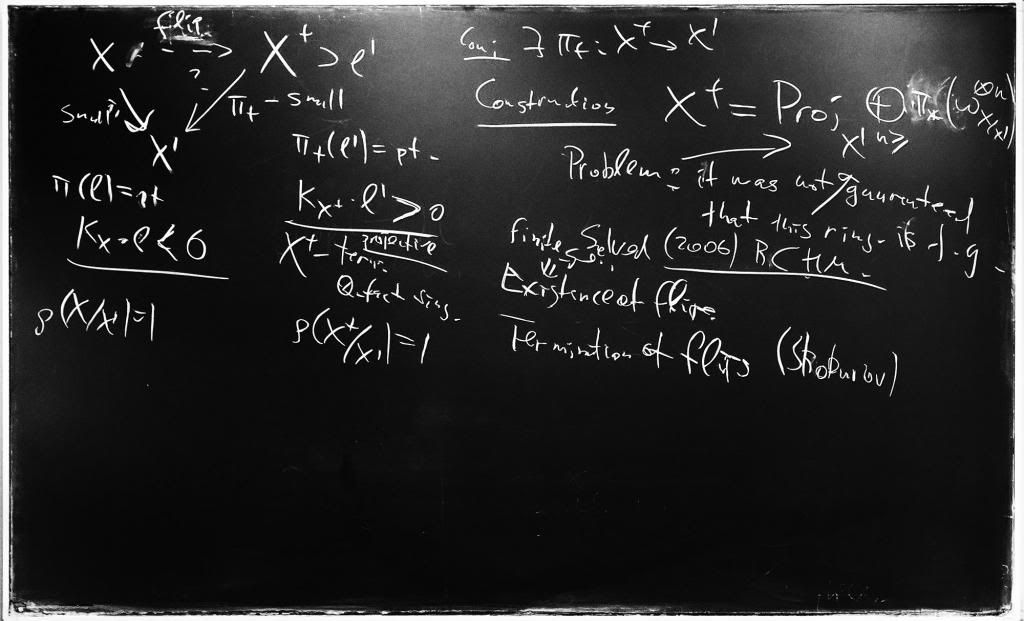
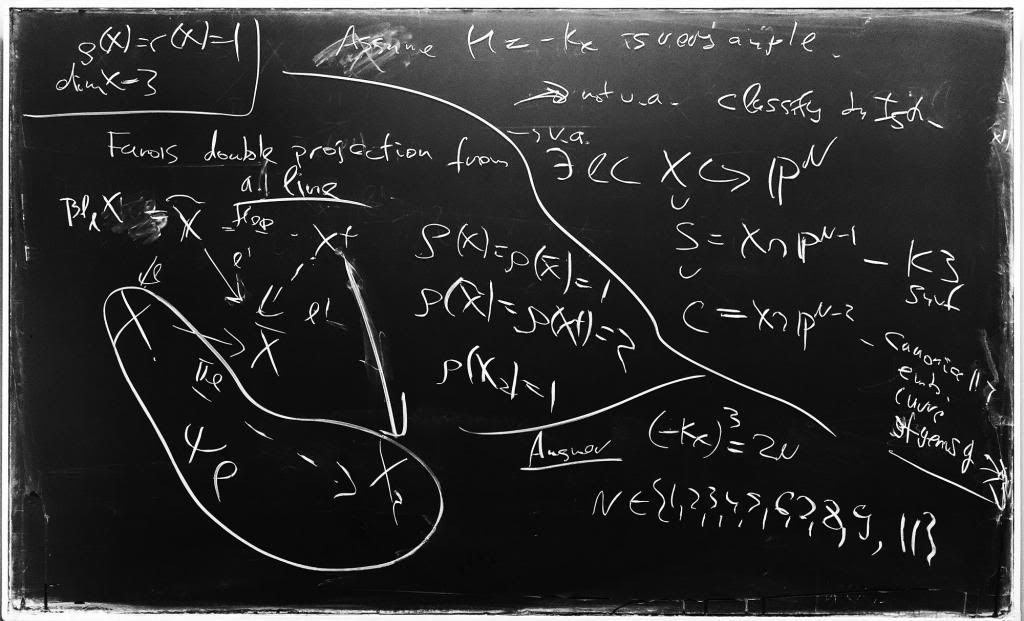
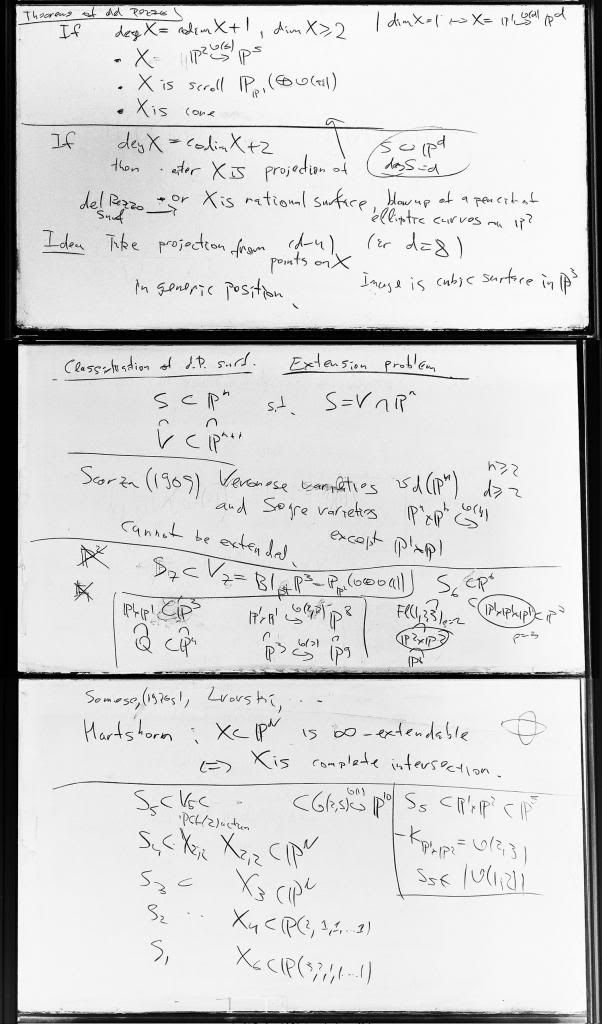
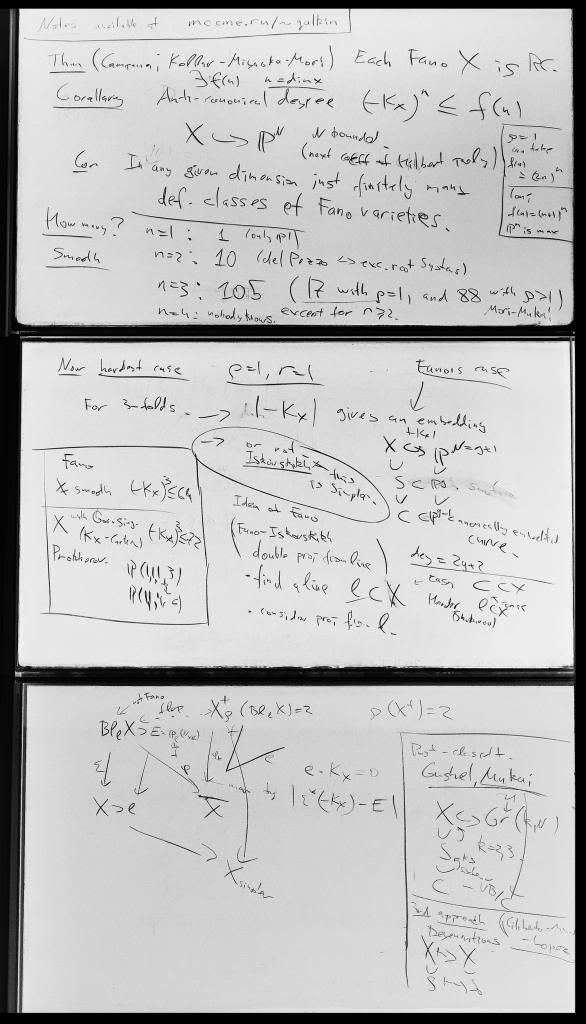
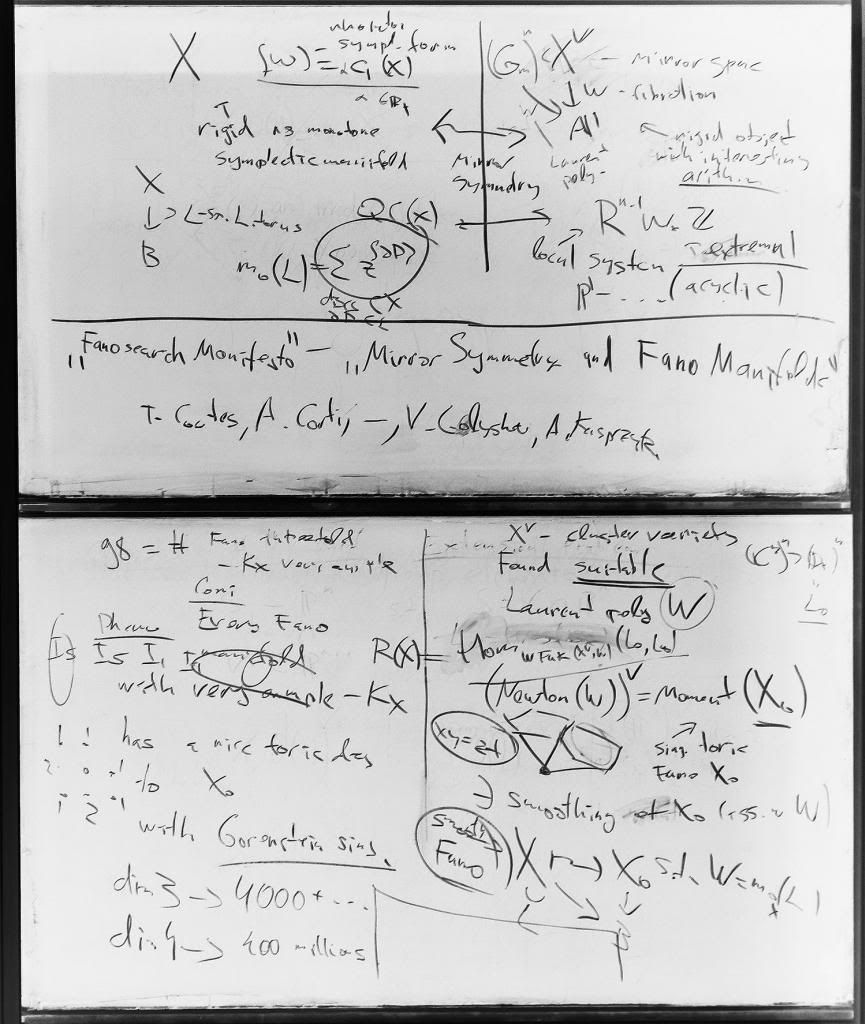
S.Galkin: Geometry of Fano manifolds.


Here are the photos of the blackboards from the lectures on the geometry of Fano manifolds by Sergei Galkin. If the speaker manages to write his lectures neatly, I'll post all the lectures. For now, here are the links to Lecture 1:


I'll keep updating.

Update 1. Here is the second lecture. Figuring out the right order of the blackboards and the logical structure of each blackboard is a non-trivial exercise (left to reader, of course).

Part 1

Part 2

Update 2. The third lecture, board by board.

Board 1
Board 2
Board 3
Board 4
Board 5
Board 6
Board 7
Board 8

Final update. Lecture 4. The first three boards are missing; they were just a brief summary of the Minimal Model Program from the previous talk.

Part 1
Part 2
Part 3
Part 4


Thursday, August 22, 2013

Minimally gilded Hodge star

Not sure how, I got into reading The Fermata by Nicholson Baker. It's all about sex, but somewhere in the middle of the book the following formula appears, allegedly from a paper called Minimally Gilded Hodge Star Operators and Quasi-Ordinary Handlebodies Within a Localizable 4-Manifold Whitney Invariants:


It is all quite meaningless, which, in itself, makes perfect sense. The narrator uses this formula as a special magic which helps to undress women. Real mathematics is useless for this purpose, to say the least, as many a mathematician must have surely observed.

There is also an example of the oppоsite situation in the book Веселая семейка by Nikolai Nosov. It is a children's book about two kids who decide to build an incubator. One of them is the type of a person who wants everything to serve a purpose; for instance, he buys a book on higher mathematics with a ridiculous name, arguing that it must be extremely useful. He can't understand a word, of course.

I read Веселая семейка at the age of six and laughed at the hapless hero. But years later (not too many years, as I understand now), while at the university, I was dumbstruck when, for some reason, the name of that mathematics book came to my mind. It was called Inverse Trigonometric Functions and Chebychev Polynomials. This is a beautiful theory, one of my favourite parts of the mathematics course.

Wednesday, August 21, 2013

A fizzy drink that must not be named

An omnipresent entity whose name must not be taken in vain. What is it?


I'm afraid I cannot tell you the answer directly since that would amount to taking its name in vain and a crazy robot will instantly sue the shit out of me. Hint: it is neither Our Lord יהוה‎ nor the Dark Lord Voldemort.  It's a bloody fizzy drink.


You can certainly pronounce its name if you want to buy it. Or discuss its positive role in the promotion of the American values around the world. Otherwise, the word is under taboo, which is broken only rarely by an intrepid soul. (This latter example, however, is an aberration which gets corrected in the Spanish language edition.)

The very existence of the taboo suggests that ____-Cola must have supernatural powers. Indeed, in the Mexican village of San Juan Chamula it is famously used in religious rituals. This has lead to some misplaced pride on part of The ____-Cola Company, which installed a custom-made billboard on the entrance to the village:


What The ____-Cola Company failed to grasp is that for Chamulans their drink represents the essence of evil. At the purification ceremony one drinks the Dark Liquid and the climax consists in belching, which symbolises the evil leaving the body.

The interpretation of ____-Cola as an embodiment of evil is also widespread among those Mexican left-wing intellectuals who drive SUVs, thrive on government funds and otherwise suffer from the injustices of this world. A high-ranking ex-colleague of mine at the National University once sent out an email proposing to remove the ____-Cola vending machine since the drink was (a) an instrument of world imperialism (b) bad for your health (c) very expensive. These people do not hesitate to pronounce the name of ____-Cola in vain; it must feel like some kind of blasphemy. [For completeness I should note that the opposite part of the political madhouse provided us with a President who started out as the president of the Mexican division of the ____-Cola Company. In his notable qualities he was second only to George W. Bush. A total idiot.]

An interesting evidence of the taboo on the name of the drink in question comes from the translation into English of the book "Generation P" by Victor Pelevin (in English it appeared as "Babylon"). It starts with a couple of pages dedicated to Pepsi-Cola. A few paragraphs survived the translation:

Once upon a time in Russia there really was a carefree, youthful generation that smiled in joy at the summer, the sea and the sun, and chose Pepsi.


It's hard at this stage to figure out exactly how this situation came about. Most likely it involved more than just the remarkable taste of the drink in question. More than just the caffeine that keeps young kids demanding another dose, steering them securely out of childhood into the clear waters of the cocaine channel. More, even, than a banal bribe: it would be nice to think that the Party bureaucrat who took the crucial decision to sign the contract simply fell in love with this dark, fizzy liquid with every fibre of a soul no longer sustained by faith in communism.

The most likely reason, though, is that the ideologists of the USSR believed there could only be one truth. So in fact Generation P had no choice in the matter and children of the Soviet seventies chose Pepsi in precisely the same way as their parents chose Brezhnev. 


Brezhnev! Cocaine channel! This looks so daring. Until you read the original, that is, and discover that a whole page disappeared in translation. This is what got omitted (I apologize for the possible linguistic atrocities):

Whatever the way it was, these kids lounged in summer on the seashore, watched the blue cloudless horizon, drank warm Pepsi-Cola bottled in the city of Novorossiysk, and dreamed that one day the prohibited faraway world from the other side of the sea would enter their lives.

Ten years passed and this world started indeed entering - first, carefully and with a polite smile, then with increasing boldness. One of its business cards was an advertisement of Pepsi-Cola - a video clip which, as many researchers noted, was a turning point in the development of the world culture. It consisted in a comparison of two monkeys. Of the them drank ''regular cola'' and, as a result, turned out to be capable of some basic manipulations with sticks and cubes. The other one drank Pepsi. Hooting cheerfully, it departed towards the sea on a jeep in the company of several gals who clearly didn't give a damn about gender equality (when dealing with monkeys it is better not to think of these things, since both equality and inequality would be equally hard to bear).

Thinking about it, it was clear that the point was not in Pepsi-Cola itself, but in the money that it was directly associated with. One came to this conclusion, first, with the help of a classical Freudian allusion by means of the colour of the product, and then, by a logical inference that the consumption of Pepsi leads to the ability to buy expensive cars. Nevertheless, we have no intention to study this video in depth (though, probably, such analysis would explain why the children of the sixties insist on calling the generation P "shitsuckers''). The only thing that matters here is that a monkey on a jeep became the final symbol of  generation P.

It did hurt somewhat to realise how the guys from the advertising agencies on Madison Avenue imagined their target group. But one cannot help but admire their deep knowledge of life. It was this very video clip that sent the message to the multitude of monkeys vegetating in Russia that the time had come to mount jeeps and take the daughters of men.

It would make no sense to blame this on an anti-Russian conspiracy. The anti-Russian conspiracy, certainly, exists, but the problem is that all the adult population of Russia is complicit in it. Pepsi-Cola, therefore, is irrelevant here. What happened was a part of a worldwide process, reflected in many books (recall "Waiting for the monkeys" by Andrey Bitov or "Brazzaville Beach" by William Boyd). This process did not spare the United States either, although things ended differently there: ____-Cola completely, definitely and irreversibly pushed Pepsi out of the red colour field, which for someone who undersands the subject is equivalent to a victory at Waterloo. This was due to the strong influence of the religious right in the United States. They do not believe in evolution; ____-Cola better fits their picture of the world since a monkey who drinks it remains a monkey. But we are talking too much about monkeys ... 


Let us be fair and admit that Pepsi also demands respect when its name it concerned. But at least you can say out loud that it is a gateway drug for cocaine ...