Thursday, August 22, 2013

Minimally gilded Hodge star

Not sure how, I got into reading The Fermata by Nicholson Baker. It's all about sex, but somewhere in the middle of the book the following formula appears, allegedly from a paper called Minimally Gilded Hodge Star Operators and Quasi-Ordinary Handlebodies Within a Localizable 4-Manifold Whitney Invariants:


It is all quite meaningless, which, in itself, makes perfect sense. The narrator uses this formula as a special magic which helps to undress women. Real mathematics is useless for this purpose, to say the least, as many a mathematician must have surely observed.

There is also an example of the oppоsite situation in the book Веселая семейка by Nikolai Nosov. It is a children's book about two kids who decide to build an incubator. One of them is the type of a person who wants everything to serve a purpose; for instance, he buys a book on higher mathematics with a ridiculous name, arguing that it must be extremely useful. He can't understand a word, of course.

I read Веселая семейка at the age of six and laughed at the hapless hero. But years later (not too many years, as I understand now), while at the university, I was dumbstruck when, for some reason, the name of that mathematics book came to my mind. It was called Inverse Trigonometric Functions and Chebychev Polynomials. This is a beautiful theory, one of my favourite parts of the mathematics course.

Wednesday, August 21, 2013

A fizzy drink that must not be named

An omnipresent entity whose name must not be taken in vain. What is it?


I'm afraid I cannot tell you the answer directly since that would amount to taking its name in vain and a crazy robot will instantly sue the shit out of me. Hint: it is neither Our Lord יהוה‎ nor the Dark Lord Voldemort.  It's a bloody fizzy drink.


You can certainly pronounce its name if you want to buy it. Or discuss its positive role in the promotion of the American values around the world. Otherwise, the word is under taboo, which is broken only rarely by an intrepid soul. (This latter example, however, is an aberration which gets corrected in the Spanish language edition.)

The very existence of the taboo suggests that ____-Cola must have supernatural powers. Indeed, in the Mexican village of San Juan Chamula it is famously used in religious rituals. This has lead to some misplaced pride on part of The ____-Cola Company, which installed a custom-made billboard on the entrance to the village:


What The ____-Cola Company failed to grasp is that for Chamulans their drink represents the essence of evil. At the purification ceremony one drinks the Dark Liquid and the climax consists in belching, which symbolises the evil leaving the body.

The interpretation of ____-Cola as an embodiment of evil is also widespread among those Mexican left-wing intellectuals who drive SUVs, thrive on government funds and otherwise suffer from the injustices of this world. A high-ranking ex-colleague of mine at the National University once sent out an email proposing to remove the ____-Cola vending machine since the drink was (a) an instrument of world imperialism (b) bad for your health (c) very expensive. These people do not hesitate to pronounce the name of ____-Cola in vain; it must feel like some kind of blasphemy. [For completeness I should note that the opposite part of the political madhouse provided us with a President who started out as the president of the Mexican division of the ____-Cola Company. In his notable qualities he was second only to George W. Bush. A total idiot.]

An interesting evidence of the taboo on the name of the drink in question comes from the translation into English of the book "Generation P" by Victor Pelevin (in English it appeared as "Babylon"). It starts with a couple of pages dedicated to Pepsi-Cola. A few paragraphs survived the translation:

Once upon a time in Russia there really was a carefree, youthful generation that smiled in joy at the summer, the sea and the sun, and chose Pepsi.


It's hard at this stage to figure out exactly how this situation came about. Most likely it involved more than just the remarkable taste of the drink in question. More than just the caffeine that keeps young kids demanding another dose, steering them securely out of childhood into the clear waters of the cocaine channel. More, even, than a banal bribe: it would be nice to think that the Party bureaucrat who took the crucial decision to sign the contract simply fell in love with this dark, fizzy liquid with every fibre of a soul no longer sustained by faith in communism.

The most likely reason, though, is that the ideologists of the USSR believed there could only be one truth. So in fact Generation P had no choice in the matter and children of the Soviet seventies chose Pepsi in precisely the same way as their parents chose Brezhnev. 


Brezhnev! Cocaine channel! This looks so daring. Until you read the original, that is, and discover that a whole page disappeared in translation. This is what got omitted (I apologize for the possible linguistic atrocities):

Whatever the way it was, these kids lounged in summer on the seashore, watched the blue cloudless horizon, drank warm Pepsi-Cola bottled in the city of Novorossiysk, and dreamed that one day the prohibited faraway world from the other side of the sea would enter their lives.

Ten years passed and this world started indeed entering - first, carefully and with a polite smile, then with increasing boldness. One of its business cards was an advertisement of Pepsi-Cola - a video clip which, as many researchers noted, was a turning point in the development of the world culture. It consisted in a comparison of two monkeys. Of the them drank ''regular cola'' and, as a result, turned out to be capable of some basic manipulations with sticks and cubes. The other one drank Pepsi. Hooting cheerfully, it departed towards the sea on a jeep in the company of several gals who clearly didn't give a damn about gender equality (when dealing with monkeys it is better not to think of these things, since both equality and inequality would be equally hard to bear).

Thinking about it, it was clear that the point was not in Pepsi-Cola itself, but in the money that it was directly associated with. One came to this conclusion, first, with the help of a classical Freudian allusion by means of the colour of the product, and then, by a logical inference that the consumption of Pepsi leads to the ability to buy expensive cars. Nevertheless, we have no intention to study this video in depth (though, probably, such analysis would explain why the children of the sixties insist on calling the generation P "shitsuckers''). The only thing that matters here is that a monkey on a jeep became the final symbol of  generation P.

It did hurt somewhat to realise how the guys from the advertising agencies on Madison Avenue imagined their target group. But one cannot help but admire their deep knowledge of life. It was this very video clip that sent the message to the multitude of monkeys vegetating in Russia that the time had come to mount jeeps and take the daughters of men.

It would make no sense to blame this on an anti-Russian conspiracy. The anti-Russian conspiracy, certainly, exists, but the problem is that all the adult population of Russia is complicit in it. Pepsi-Cola, therefore, is irrelevant here. What happened was a part of a worldwide process, reflected in many books (recall "Waiting for the monkeys" by Andrey Bitov or "Brazzaville Beach" by William Boyd). This process did not spare the United States either, although things ended differently there: ____-Cola completely, definitely and irreversibly pushed Pepsi out of the red colour field, which for someone who undersands the subject is equivalent to a victory at Waterloo. This was due to the strong influence of the religious right in the United States. They do not believe in evolution; ____-Cola better fits their picture of the world since a monkey who drinks it remains a monkey. But we are talking too much about monkeys ... 


Let us be fair and admit that Pepsi also demands respect when its name it concerned. But at least you can say out loud that it is a gateway drug for cocaine ...


Monday, July 29, 2013

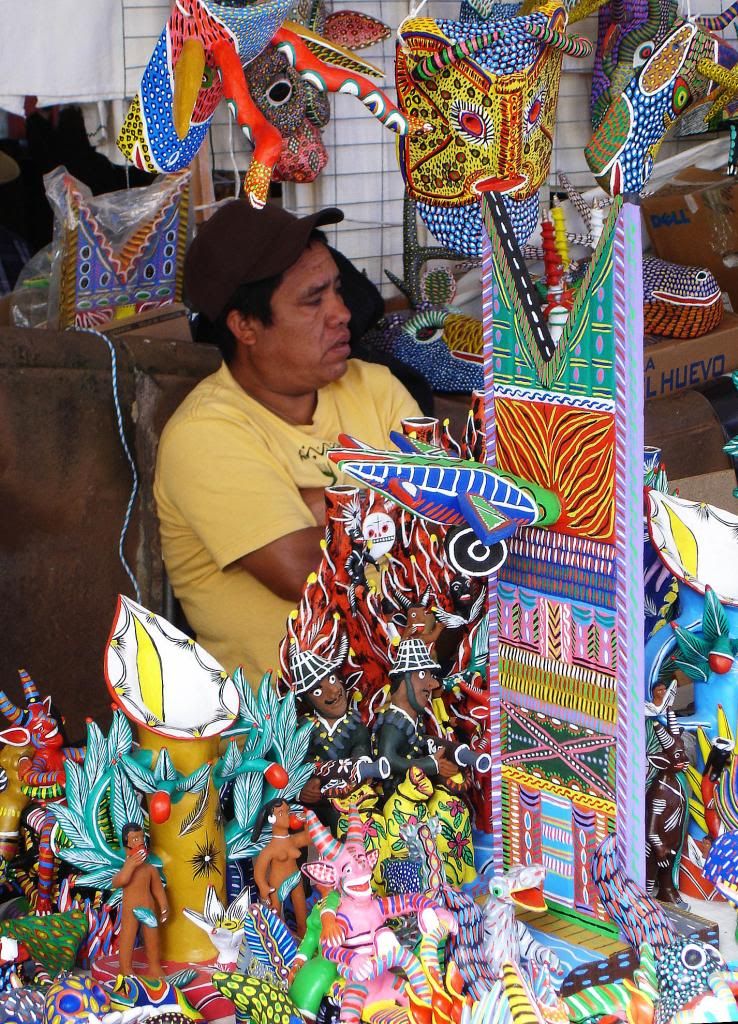
Ocumicho art after 9/11


This is a photo from 2004. Pátzcuaro, el día de muertos. The colorful construction on sale is supposed to represent one of the towers of the World Trade Center. Whatever is glued to the middle of it is meant to be an airplane. The firemen with hoses also belong to the composition. The second tower is wrapped in plastic, in the box behind the sleepy seller.

There are other interesting things at the same stall, such as a scene of the fall of Adam and Eve, together with numerous devils. One glance at the forbidden fruit is enough to see why it had been forbidden.

If this seems sinister, you should have visited the same market last year. Ocumicho artisans by then had found new themes. A fellow hanging another fellow on a tree, the girlfriend of the victim weeping on her knees. Robbers shooting at travelers on a road. And - a model of hell, which looked like Earth on fire, with devils flying around it on thin wires. First place at the artisans' exhibition. 

Alas, photography was not allowed, apparently, in order to prevent pirated copies of hell from appearing on the black market.

A larger photo is here.

Thursday, July 4, 2013

Tears, dreams and dung

About 20 years ago the British Council decided to do some missionary work in Russia, and the Moscow Metro got a program similar to Poems on the Underground. Instead of shampoo advertisements some trains started carrying brief English poems together with their Russian translations. 

This did not play out well. The British Council made a critical mistake: they chose the poems first and then commissioned the translations. At least, this is the only explanation I can find for the disaster that ensued. A few brilliant lines by Rupert Brooke

Unkempt about those hedges blows

An English unofficial rose;
And there the unregulated sun
Slopes down to rest when day is done,
And wakes a vague unpunctual star ...

became something that started as

У изгороди, над горой навоза,
пробилась неофициально роза ...


In the translation the rose was not English anymore, nor it was unkempt. On the other hand, a new circumstance appeared: it grew over a pile of dung. I can't really blame the translator, she did what she could. There are few words in Russian that rhyme with rose: tears, dreams and, well, dung. Tears and dreams were, obviously, out of place.

And, indeed, a Russian village often smells stronger than the English countryside. But the commuters were not amused at all.  They did not like reading "this foreign stuff" (as if they could actually read it) and they did not like excrement. After a few months on the orders of the mayor of Moscow the program was terminated and fine English poetry was replaced by standard primary school propaganda, written, apparently, by some loyal Uzbek:

Москва, Москва!.. люблю тебя как сын,
Как русский, - сильно, пламенно и нежно!

Moscow, Moscow, I love you as a son,
As a Russian, etc.


As everything touched by the hand of the Moscow government, this was real crap.

Monday, July 1, 2013

Бродский в Мексике

... Направо
пойдешь - там стоит агава.
Она же - налево. Прямо -
груда ржавого хлама.

Перечитал "Мексиканский дивертисмент".

Иосифу Бродскому в Мексике не понравилось. Поэтому в "Мексиканском дивертисменте" он переврал названия городов,  некоторые другие географические факты, а также имена и этническую принадлежность исторических персонажей.

Первое же стихотворение называется "Гуернавака". Нетрадиционная ошибка, обычно Куэрнаваку неправильно называют "Куэрневакой" (американцы) или "Тегусигальпой" (Михаил Фишман).  Конечно, само название "Куэрнавака", из которого торчат какие-то бессмысленные коровьи рога - плод косноязычия испанцев, не сумевших выговорить "Куаунáуак"; ну да, бог с ней, с Куэрнавакой. Жуткое место. Густо набранное "Ж".

В "мексиканском романсеро" повторяется не раз "вечерний Мехико-Сити". Загадочное название. "Мехико" - по-испански, "Сити" - по-английски, а все вместе - как бы по-русски. Вроде "Нью-Москвы" Остапа Бендера или "Москвы-Сити" Юрия Лужкова, будь он неладен. Вообще, большинство русских говорят "Мехико-Сити". Неужели все Бродского читали?

И так далее. Не очень серьезные ошибки, у других поэтов хуже бывает. Стихи местами хорошие, хотя содержание сводится к тому, что в отсталых странах жизнь внушает тоску:

Куда ни странствуй,
всюду жестокость и тупость воскликнут: "Здравствуй,
вот и мы!"

К сожалению, потом идут выводы:

Все-таки лучше сифилис, лучше жерла

единорогов Кортеса, чем эта жертва.

Речь идет об ацтекских жертвоприношениях, конечно. Спорить не буду, поскольку уже не с кем. Но сифилиса не надо.

Thursday, June 27, 2013

Moxifloxacin-induced nightmare review

"This is poison," my doctor said, handing me a prescription for Avelox, "but all antibiotics are, to some extent." I am tired of being ill, I will drink whatever posion is promised to help. Still, the warning is unusually stark. A search for side-effects reveals permanent blindness and a few other equally thrilling ailments; however, they are all rare. And then I see that fun is just around the corner. "Moxifloxacin," I read, "may induce nightmares, unusual thoughts or behavior". I take a pill and go to sleep full of anticipation.

My dreams, when can I remember them, are monotonous and autistic. Usually they consist of aimless wandering through some unknown cities, with hardly any human interaction, an experience similar to a first-person shooter game with the difficulty level set to "few monsters". In one particular scenario that I see every now and then I go back to Moscow to dicover that while I was away several new metro lines had been built. Then, of course, I have to navigate the unfamiliar maze of interchanges and take train after train. I used to derive some pleasure from trying to recall the metro map in the morning, weird colors, strange loops and all, but then I went to Japan. The complete map of Tokyo railway lines beats my dreams hands down.

Avelox gave me a gun. I dreamt that I was sitting in the middle of Avenida Insurgentes spraying the traffic with bullets. Shattered glass was everywhere, but cars kept coming. Every now and then a big red bus would pass spitting a cloud of black smoke in my face (this was a nightmare, after all). In spite of this, I am pleased to report that I did not shoot at public transport. I was expecting a stand-off with the police, but this being Mexico, the police never came, so I decided to escape. 

Here I fell into the old scheme of running through an unfamiliar urban landscape, only this time I was followed by a nasty-looking guy (think of Jean Reno wearing black round glasses) who would jump with joy each time he found my next hideout. I had spent all my bullets on innocent commuters, so I had to take shelter in houses, repair shops and so on, and talk to the people. One young man, seeing my distress, tried to calm me down by saying that his father was an assassin like me, and there is nothing wrong with it, this is just a job like any other job. When I felt I couldn't run any more I woke up. I was tired as if I had actually done all the running and shooting. 

So far, I would rate the experience as 3 stars out of 5. You can get this shit on Playstation, no need to take antibiotics, and you don't get as exhausted. On the other hand, not that I had any choice. They say that Avelox is really good at killing bugs.


Now I am having a good rest. The next pill is scheduled for midnight.

Tuesday, June 18, 2013

An angry rant of an orthography vigilante

Everyone has surely witnessed the sorry and ridiculous sight of a native English speaker trying to show off his knowledge of a foreign language. What I did not realize until now is that even the supreme masters of English prose suffer at times from the delusion that they can speak tongues, such as Spanish, without assistance.

Hitch-22 by Christopher Hitchens is an example. It is set out in the most powerful and clear English style, though, as soon as alcohol is mentioned, emotions ruin its perfection somewhat. I thoroughly enjoyed the book until Hitchens started speaking Spanish. Che Guevara no ha muerte! Must be a misprint. But then: libertad por los maricons! Oh, no. Finally: cono! This potent swearword denotes in Spanish either a union of lines passing through a common vertex, or the reproductive organ of a fir tree. Yes, the female organ, but of a fir tree, for God's sake.

One might argue that Hitchens was a communist and, hence, an enemy of orthography as such. But then, he was the enemy of Spanish orthography only, his English being far above impeccable. Also, he liked Margaret Thatcher. Most probably, he simply wrote down whatever his memory threw up and the copyeditor at Hachette couldn't be bothered to do his job. Worse things happen: I was bewildered when the Cambridge copyeditor replaced the word compatibility in my book by a monstrous compitibility.

And then I read Blood Meridian by Cormac McCarthy. This is pure magic - black magic, if you take the content into the account - but still nothing short of supernatural, an amazing show of killing power the English language can have. The bloodletting in the book alternates between US and Mexico and there are many Spanish words embedded into McCarthy's prose. Such as piñole, a mysterious substance consumed throughout the book. McCarthy didn't quite make it up: pinole does, indeed, exist. Pinole, not piñole. This spurious tilde looks as dreadful to my eye as a fake accent in the name of some pseudo-French establishment, designed to make it look more authentic, more boutique.

Now, I am not easily scared by a misplaced tilde - this is really a minor mistake - and do you know that Nabokov wrote bycyle in his drafts? - but I was reading the 25th anniversary edition, freshly reset in print. How does an error survive for so long? Did anyone read the book?

Another scare I suffered while reading Blood Meridian was the station of Alamo Mucho. In this case, however, McCarthy was innocent: this was an authentic example of the Great American Toponymical Imbecility so widespread in the south of the US. I guess the monkey who gave this name to the place formerly known as Alamo Mocho thought that Mexicans, being utter savages, cannot be trusted with their own language. Mocho? What the fuck is mocho? It must be mucho - you know, because, besame mucho. (I'm afraid I have seen this attitude in people with PhD's in exact sciences. Nowhere to hide.)

I think I have complained enough. There's just one mystery I absolutely must mention since the place names were brought up. How is it possible to call a town Rio Vista in a country where every other inhabitant can tell you que no, señor, esto no tiene sentido?